#3 The Blue Hour interviews: Derek Seaward
Firstly, can you tell us a little about yourself, your work (photography or non-photography) and your preferred style to shoot?
As a Professional Photographer for a long period of time, I have encountered most of the highs and lows of the industry. I have worked with a large number of Creative people on many sides of the business, including Advertising Agency Creative Directors, Art Directors and Copywriters in the UK, USA and many European Countries. I have employed many Assistants who have gone on to become successful photographers in their own right. Freelance Hair and Make-up artist, Set Builders, Scenic Artists, Stylists, Home Economists, Magazine Writers, Magazine Art Editors, Actors, Models as well as a few Film Directors have all been part of my crews over the length of my career.
I have been fortunate to work with these people and have managed to organise crews up to 40 in number and covered all aspects from small to large studios, small locations to building large sets in many places home and overseas.
I have been Chairman of the Association of Photographers and served on many Councils within that Association, which helps its members from Student to Top Professional Photographers with help from all corners, especially on Copyright, its Awards and wealth of knowledge within its members.
I enjoy and love all aspects of Photography and always look forward to being able to pass my knowledge onto others that share my enthusiasm. Like all things there is never an answer but there is always a way to achieve what you want. And hopefully I can give some idea where to start and help you decide which way go.
We must always remember to enjoy everything we do, that we learn from our mistakes and every piece is essential to make the jig saw complete.
I love taking Photographs, I love Football, Welsh Rugby and all sports. I love collecting antiques, Radio 4, and music, all types. I love to travel especially for work. Humour is a large part of my life and to hear people laughing is one of the delights of life. I take great pleasure in family life and adore all of my Family.
When did photography start for you? Is there a specific memory that kick-started it all?
Born in Swansea, eldest son of 9. My father was a fisherman. So I should have followed, but I didn’t go to sea I became an accountant. I would when young go regularly to the cinema with my Mother, and was always fascinated by the big white rectangle ( the screen ) in front of me and how suddenly Images would appear. Then one day in my teens my step-grandfather gave me a pull out Kodak camera which took picture in a rectangle the same as that screen, when I looked through the view finder, I realised I could create images of my own, so started taking pictures in my spare time. One day outside the back of my house men were painting all the walls white, and changing the Radio shop opposite into a pub ??? I asked the people involved and was told, they were make a movie, the white walls would reflect the light as they would be shooting at night. I watched night and day as they transformed the street, by adding Phone boxes and anything else they needed, used large lights with Fresnel screens that clunked when switched on and off. I knew then, that not only did I want to take pictures, I wanted to create pictures, I wanted to use those lights ( And subsequently did as I bounced those tungsten lights around large cars studio to create memorable car images.)
After 2 years, I won a place at MCA a prestigious photographic course in Britain. A new life, realizing the beauty of how light fell on objects from dawn to dusk and, using artificial light to replicate the same in the studio. I started in fashion, spent a year assisting. But with my love of light, the still life images in my portfolio gave me my first small commissions. It also got me a job assisting the still life photographer, David Thorpe. 2 years later I had the portfolio and confidence to face the world of London advertising. Had my first studio and was shooting campaigns and winning entries in D&AD. An Art director who loved the way I would light my subjects, asked me do the same with cars. It was what I needed. Shooting autos challenged me more and more, in both studio and location. I had found a world I loved, large objects shot around the world in all the places I dreamed of. Allowing me to travel across Europe, E and W coasts of the USA and S/Africa. The challenge of large shoots over many weeks with crews of up to 40 gave me the rewards I wanted – building large sets in strange places, battling the weather, languages, waiting for the right light and making friends around the world. I would also take my own pictures, taking extra days to see more of where I was invading. The volume of these personal pictures grew and I felt I needed to show them. I did this in many ‘One Man Shows’ and Joint exhibitions. The response was surprising selling my personal work felt the same as passing a poster I had shot, or opening a magazine to see my pictures. After many years, my portfolio has become so varied and to make sense of such a volume is difficult. I continue to work in advertising, My love of photography never wanes, I get the same thrill from every picture I take. My Clients are vast and varied.
Who are your influencers? And how have they shaped how you shoot?
My first influences came from the Cinema followed by my time at Medway College of Art, where I was, not only taught all the necessary techniques to achieve what I wanted, but also to study the photography of others. …… My greatest influences from their work, have been Walker Evans, Paul Strand, Phil Marco, and Irvine Penn the quality of their lighting is staggering, their composition and attention to detail is superb, they have taken pictures you feel when you look at them, they have a presence. As a photographer you have a great deal of emotion and when you take a picture, this is what you put into it, so when you see photographs that have the same feeling then you just enjoy and feel inspired. Closer, I worked for the late David Thorpe and he had a great influence on my work and my life, teaching me true professionalism, respect for my craft and that photography can be an Art. He also had that passion that makes a great image maker and great Images. A joy to be with and he always introduced me as his assistant who worked with him and not for him. When I got my own studio and started to work for myself, I would go into an advertising Agency and there I saw Art Directors drawing the same rectangle as my screen, then with their pens and markers filling the page with the ideas for ads they wanted to create. Ideas that I wanted to bring to life for them. So they too had a great influence on my life and shaped the way I approached my photography.
What do you love about photography? Is there anything you dislike about it?
I love absolutely everything about photography, I love To create images, I love to light people, objects and shapes and to work with others. As previously said I love to bring to life, in Camera my own images and the ideas. Those ideas of Creatives from Agencies, Magazines and Designers. The thrill of seeing ones work on a Poster or in a Magazine never wanes and always excites and gives me a tingle inside.
Do I hate anything about photography, not really a lot, if anything, mostly, people who underrate the amount of effort one goes to, to make sure the image is exactly as wanted and to give them the same tingle inside.
Do you have a favourite project/image and why?
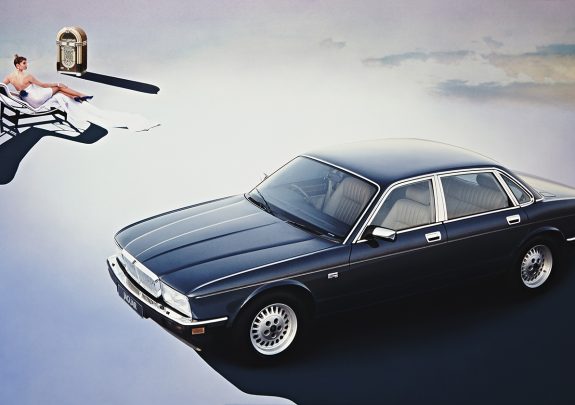
I have had many favourite project over the years, and one in particular was to do a series of ads for Jaguar Cars, which I shot in Antibes in the South of France.
These were shot for 48 sheet posters and press ads and the brief from the Art Director was to shoot them as a tribute to Salvador Dali or Daliesque…. how they were shot is, Myself and the Art Director had a set builder, build us a set 100 feet square on the coast at Antibes facing the sea. We then had the floor painted as a generic background for each image. Then later at night we set up a 10k light to get the effect of back lighting the cars and any object to be in the image creating the same shadows that would be if shot at sunset, then with black paint, painted the shadows in front of the cars and objects. Left overnight with a security guard, we returned the next morning and shot the cars at sunrise, which meant the cars were all lit from the front morning light showing all the detail and shape of the cars, and because of the painted shadows the whole picture appears to be back lit …. Which it is not. Obviously done before heavy digital postproduction … all shots were done on 10 x 8 Film on a Gandolfi wooden plate camera. A satisfying achievement. Pre Photoshop. These are projects I like.
For myself I have been shooting a project which is of shop windows that contain mannequins with my reflection as part of the image. Also projects photographing trees, flowers and nudes, anything that has beautiful shapes and a lighting challenge.
What do you think makes a good photo?
I feel that any image that people want to look at is a good photograph, a difficult question to answer, but for me, it will be a professional photograph that shows all the attention to detail that makes one admire it and have all the emotion felt when you see the image in front of you. For instance in Penn’s pictures of models, the clothes are not only amazingly well prepared and presented but they look like the model chosen is made for the clothes and the clothes made for the model. A small example but as Penn says our images are moments in time. On a documentary front Sebastiao Salgado’s photographs are a perfect example of great quality, huge emotion and a sense you are there with him. From from the best advertising, top fashion Magazines to the wonders of National Geographic, we are blessed with a plethora of amazing images. Just sit and look, some will take your breath away.
What advice would you impart to a budding photographer?
The greatest thing about Professional Photography that I could share is, the word Professional. Taking great pictures is in the eye not in the equipment you use, as with all creations, a great book is not a great book because the author has a great typewriter, it’s because he has a great story. BUT – having the best typewriter does enable people to read it clearly… and so it is with pictures. Having the right equipment is essential if you want people to enjoy the beauty and clarity of what your eyes see.
A professional picture, especially a commissioned one, is not just picking up a camera, clicking and hey presto that’s it… if only. No – when given a brief, you have to study it then start to imagine how you are going to bring it to life, as a film director does when he finds a good script. For a Location shoot you need to begin to put your crew together; get a location finder to find the right location, you might need a good producer to get the permissions and permits for the shoot. You will need Assistants to be your second and third pair of eyes, to help with as much as possible, allowing you, the photographer to concentrate on the picture. The equipment needed is not only cameras and lenses, but tripods, stands, flags, grips, cleaning equipment, battery power, tables, general tools, like screwdrivers etc., the list goes on!
Carnets for foreign travel, transportation hire or Flights, Hotels, subsistence, then specifics – if you need rigs, hoists, and safety equipment etc. You will need a good Stylist to get your props, possibly Hair and Make-up, Models and Casting. Sometimes all this has to be done and sorted within 24 hours. A lot of the same things apply to a Studio shoot, with the emphasis being more on the lighting, size of studio, etc., Plus you need to work out a budget for all these things and present a quote to the client before getting the final OK.
So, as you can see, there is a lot to learn and lot to do, even before a shutter is clicked… and I have probably missed out a few things. When you are on the location you have to make sure, as well as taking the picture, that you are controlling all these people and they are doing the job properly, especially staying within your budget. All done, and back to the office; process the film or Raw files, make a record of all the expenses and log the receipts, then finally, of course, do the billing.
This is what professional photography is all about – being professional, providing the best service in all departments, at all times, to your client. For me, whilst doing all this, I like to make sure that we all have fun whilst we are doing it. It’s a great profession and we must enjoy every minute of it and a happy crew is a great crew. I’ve had some great crews and some fantastic journeys and a wonderful time. And long may it continue. There are many tales to tell and with hard work comes a great deal of wonderful experiences. For me… being in Death Valley with Dennis Hopper and recreating Easy Rider for Ford Cougar, to shooting Jaguar in the South of France and closing down The Promenade Anglaise” in Nice for a night shoot. Being taken back to the Police station in Portugal after they had closed more roads than I thought possible in one day, we all got drunk and they gave me an escort back to Lisbon. Being in the wrong location for my permit in South Africa, but not wanting to move as the shot was just right and the light …. But when the policeman pulled his gun and his assistant said he will shoot you if you don’t go! Fastest wrap ever.
From “Catcher in the Rye” by J.D.Salinger my favourite book on life
“. .And I’m standing on the edge of some crazy cliff. What I have to do, I have to catch everybody if they start to go over the cliff—I mean if they’re running and they don’t look where they’re going, I have to come out from somewhere and catch them. That’s all I’d do all day. I’d just be the catcher in the rye and all.”
Which is like being on a shoot, one must catch everything, make sure all is working well, and that everyone is on top of their game.
Think about the image and your reputation and not about profit. Realise that it might be your only chance you get. Don’t use the T.V. type excuse …. Given another chance I will do better, I have so much to give !!!!! You may never get another chance. Do your best always, no matter how small the job.
Where do you think photography will be in 50 years time?
I am sure it will exist if we do. Very much the same, but with more advanced technology, more advance methods and more people creating their own images. Taking pictures is a lot different to creating photographic Images. We have many ways of reading and listening to literature but we still only have one way of creating it. Whether it is written by hand or on a device, it is created the same way as it always has been from the mind. And imagery is the same, it is what we see and what we want to create for others to see, and I cannot see this ever changing.